Buy europeanagenda.eu ?
We are moving the project
europeanagenda.eu .
Are you interested in purchasing the domain
europeanagenda.eu ?
domain@kv-gmbh.de · 0541-91531010
Buy europeanagenda.eu ?
What are the differences between covalent bonds, metallic bonds, and ionic bonds?
Covalent bonds are formed when two atoms share electrons, resulting in a strong bond between the atoms. Metallic bonds occur between metal atoms, where the electrons are delocalized and free to move throughout the structure, creating a strong bond. Ionic bonds are formed between a metal and a nonmetal, where one atom transfers electrons to the other, resulting in the formation of positively and negatively charged ions that are attracted to each other. Overall, covalent bonds involve electron sharing, metallic bonds involve electron delocalization, and ionic bonds involve electron transfer. **
Do CO bonds form with other CO bonds?
No, CO bonds do not typically form with other CO bonds. Carbon monoxide (CO) is a stable molecule with a triple bond between the carbon and oxygen atoms. This triple bond is strong and does not readily form additional bonds with other CO molecules. Instead, CO molecules tend to interact with other types of molecules through various types of chemical reactions. **


Similar search terms for Bonds
Top-Angebote
Products related to Bonds:
-
NIVEA MEN economy pack MNIVEA MEN, , Beauty gift sets for Men, Everything for beautiful-looking skin in one package. The NIVEA MEN beauty gift set contains not one but several products to help you create or enrich your daily beauty routine and make you or your loved ones happy to get it as a gift. The set contains: NIVEA MEN Hyaluron moisturising cream with anti-wrinkle effect 50 ml NIVEA MEN Original cream for men 150 ml Characteristics: a set of cosmetic products for everyday use products for deep nourishment and hydration comprehensive care for everyday routine the product is specially developed for the needs of men’s skin a set at a favourable price How to use: Use every product from the cosmetic set according to the instructions.15,60 £*Shipping: 3,99 £Secure redirect to the provider
-
Signal White Now economy packSignal White Now, 3x75 ml, Whitenning toothpaste for Women, The Signal White Now toothpaste is intended for gentle tooth whitening. It removes unwanted pigmentation from the teeth effectively and with regular use will reward you with a brighter smile. The set contains: Signal White Now toothpaste with whitening effect 75 ml Characteristics: whitens teeth fights tooth decay and plaque guaranteed to be gentle on tooth enamel revitalises and looks after gums How to use: Use at least twice a day. Clean the teeth thoroughly for at least two minutes. For further treatment of the teeth, use dental floss or an interdental brush.10,70 £*Shipping: 3,99 £Secure redirect to the provider
-
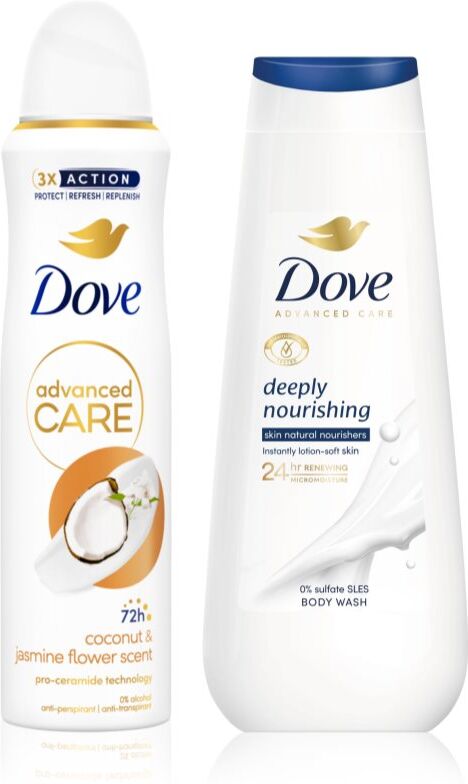
Dove Advanced Care economy packDove Advanced Care, 2 pc, Antiperspirants for Women, Treat yourself or your loved ones to the perfect cosmetic set. The set contains: Dove Advanced Care Coconut & Jasmine Flower Scent deodorant spray 150 ml Dove Advanced Care Deeply Nourishing moisturising shower gel 400 ml Characteristics: washes the skin and gets rid of dirt leaves skin velvety soft and smooth moisturises intensely softens and improves the skin’s elasticity provides effective protection against perspiration protects against unpleasant odours leaves a long-term feeling of freshness does not block natural bodily processes a treat for any woman a set at a favourable price How to use: Use every product from the cosmetic set according to the instructions.7,70 £*Shipping: 3,99 £Secure redirect to the provider
-
HARPERCOLLINS Creative Confidence by Tom & David Kelley – Unleashing Your Creative Potential & Innovation MindsetA powerful and inspiring book from the founders of IDEO, the award-winning design firm, on unleashing the creativity that lies within each and every one of us. Too often, companies and individuals assume that creativity and innovation are the domain of the ‘creative types’. But two of the foremost experts in innovation, design and creativity on the planet show us that each and every one of us is creative. In an entertaining and inspiring narrative that draws on countless stories from their work at IDEO, and with many of the world's top companies and design firms, David and Tom Kelley identify the principles and strategies that will allow us to tap into our creative potential in our work lives, and in our personal lives, allow us to think outside the box in terms of how we approach and solve problems. ‘Creative Confidence’ is a book that will help each of us be more productive and successful in our lives and in our careers.4,95 £*Shipping: 1,99 £Secure redirect to the provider



-
Why are intermolecular bonds weaker than electron pair bonds?
Intermolecular bonds are weaker than electron pair bonds because they involve interactions between molecules rather than within a single molecule. In intermolecular bonds, the attractive forces between molecules are generally weaker than the covalent bonds that hold atoms together within a molecule. Additionally, intermolecular bonds are typically temporary and can be easily broken, whereas electron pair bonds are strong and stable. Overall, the weaker nature of intermolecular bonds allows molecules to move and interact with each other more freely. **
-
Why are intermolecular bonds typically weaker than covalent bonds?
Intermolecular bonds are typically weaker than covalent bonds because they involve interactions between molecules rather than within a single molecule. In intermolecular bonds, the attractive forces between molecules, such as van der Waals forces or hydrogen bonding, are weaker than the strong sharing of electrons in covalent bonds. Additionally, intermolecular bonds are more easily broken or disrupted by changes in temperature or pressure, leading to lower bond energies compared to covalent bonds. **
-
Why are intermolecular bonds generally weaker than covalent bonds?
Intermolecular bonds are generally weaker than covalent bonds because they involve interactions between molecules rather than within a single molecule. Covalent bonds involve the sharing of electrons between atoms, creating strong bonds within a molecule. In contrast, intermolecular bonds, such as hydrogen bonds or van der Waals forces, are weaker because they are based on temporary interactions between molecules, which can be easily broken. Additionally, intermolecular bonds are influenced by factors such as distance and orientation, further contributing to their weaker nature compared to covalent bonds. **
-
Why does it boost the economy when the ECB buys bonds?
When the European Central Bank (ECB) buys bonds, it injects money into the financial system, which lowers interest rates and encourages borrowing and spending. This increased liquidity in the market stimulates economic activity, leading to higher investments, job creation, and overall economic growth. Additionally, by purchasing bonds, the ECB can help stabilize financial markets, reduce borrowing costs for governments and businesses, and support the flow of credit to households and companies, all of which contribute to a healthier economy. **


Why are primary bonds stronger than secondary bonds in chemistry?
Primary bonds, such as covalent and ionic bonds, are stronger than secondary bonds, such as hydrogen bonds and van der Waals forces, because they involve the sharing or transfer of electrons between atoms. This results in a more stable and tightly held bond. In contrast, secondary bonds are based on weaker electrostatic interactions between molecules or atoms, such as dipole-dipole interactions or temporary induced dipoles, which are not as strong as the sharing or transfer of electrons in primary bonds. Therefore, primary bonds have a higher bond energy and require more energy to break compared to secondary bonds. **
What is the difference between ionic bonds and covalent bonds?
Ionic bonds form between two atoms when one atom transfers one or more electrons to another atom. This results in the formation of positively charged ions (cations) and negatively charged ions (anions) that are attracted to each other. Covalent bonds, on the other hand, form when two atoms share one or more pairs of electrons. This sharing of electrons creates a strong bond between the atoms. In summary, ionic bonds involve the transfer of electrons, while covalent bonds involve the sharing of electrons. **
Top-Angebote
Products related to Bonds:
-
Inspired Finds Eternal Bonds Personalized Acrylic Photo Frame & Custom Couple Plaque Gift warm LightCapture Your Timeless Connection. Turn your most meaningful moments into a lasting keepsake with this elegant personalized acrylic photo frame. Designed specifically for couples who value memories that matter, this sleek, transparent display piece...110,99 $*Shipping: 0,00 $Secure redirect to the provider
-
Dove Original economy packDove Original, 3x150 ml, Antiperspirants for Women, Everything for beautiful-looking skin all in one package. The Dove Original beauty gift set contains not one but several products to help you create or enrich your daily beauty routine and make you or your loved ones happy to receive it as a gift. The set contains: Dove Original antiperspirant deodorant spray 48h 150 ml Characteristics: protects against unpleasant odours adds freshness provides long-lasting protection does not leave stains on clothing does not irritate the skin ensures a long-term feeling of freshness does not block natural bodily processes nourishes and cares for the skin a treat for any woman a set at a favourable price Ingredients: no alcohol How to use: Apply to clean, dry skin under the arms. Suitable for everyday use.10,10 £*Shipping: 3,99 £Secure redirect to the provider
-
NIVEA MEN economy pack MNIVEA MEN, , Beauty gift sets for Men, Everything for beautiful-looking skin in one package. The NIVEA MEN beauty gift set contains not one but several products to help you create or enrich your daily beauty routine and make you or your loved ones happy to get it as a gift. The set contains: NIVEA MEN Hyaluron moisturising cream with anti-wrinkle effect 50 ml NIVEA MEN Original cream for men 150 ml Characteristics: a set of cosmetic products for everyday use products for deep nourishment and hydration comprehensive care for everyday routine the product is specially developed for the needs of men’s skin a set at a favourable price How to use: Use every product from the cosmetic set according to the instructions.15,60 £*Shipping: 3,99 £Secure redirect to the provider
-
Signal White Now economy packSignal White Now, 3x75 ml, Whitenning toothpaste for Women, The Signal White Now toothpaste is intended for gentle tooth whitening. It removes unwanted pigmentation from the teeth effectively and with regular use will reward you with a brighter smile. The set contains: Signal White Now toothpaste with whitening effect 75 ml Characteristics: whitens teeth fights tooth decay and plaque guaranteed to be gentle on tooth enamel revitalises and looks after gums How to use: Use at least twice a day. Clean the teeth thoroughly for at least two minutes. For further treatment of the teeth, use dental floss or an interdental brush.10,70 £*Shipping: 3,99 £Secure redirect to the provider
-
What are the differences between covalent bonds, metallic bonds, and ionic bonds?
Covalent bonds are formed when two atoms share electrons, resulting in a strong bond between the atoms. Metallic bonds occur between metal atoms, where the electrons are delocalized and free to move throughout the structure, creating a strong bond. Ionic bonds are formed between a metal and a nonmetal, where one atom transfers electrons to the other, resulting in the formation of positively and negatively charged ions that are attracted to each other. Overall, covalent bonds involve electron sharing, metallic bonds involve electron delocalization, and ionic bonds involve electron transfer. **
-
Do CO bonds form with other CO bonds?
No, CO bonds do not typically form with other CO bonds. Carbon monoxide (CO) is a stable molecule with a triple bond between the carbon and oxygen atoms. This triple bond is strong and does not readily form additional bonds with other CO molecules. Instead, CO molecules tend to interact with other types of molecules through various types of chemical reactions. **
-
Why are intermolecular bonds weaker than electron pair bonds?
Intermolecular bonds are weaker than electron pair bonds because they involve interactions between molecules rather than within a single molecule. In intermolecular bonds, the attractive forces between molecules are generally weaker than the covalent bonds that hold atoms together within a molecule. Additionally, intermolecular bonds are typically temporary and can be easily broken, whereas electron pair bonds are strong and stable. Overall, the weaker nature of intermolecular bonds allows molecules to move and interact with each other more freely. **
-
Why are intermolecular bonds typically weaker than covalent bonds?
Intermolecular bonds are typically weaker than covalent bonds because they involve interactions between molecules rather than within a single molecule. In intermolecular bonds, the attractive forces between molecules, such as van der Waals forces or hydrogen bonding, are weaker than the strong sharing of electrons in covalent bonds. Additionally, intermolecular bonds are more easily broken or disrupted by changes in temperature or pressure, leading to lower bond energies compared to covalent bonds. **
Similar search terms for Bonds
-
Dove Advanced Care economy packDove Advanced Care, 2 pc, Antiperspirants for Women, Treat yourself or your loved ones to the perfect cosmetic set. The set contains: Dove Advanced Care Coconut & Jasmine Flower Scent deodorant spray 150 ml Dove Advanced Care Deeply Nourishing moisturising shower gel 400 ml Characteristics: washes the skin and gets rid of dirt leaves skin velvety soft and smooth moisturises intensely softens and improves the skin’s elasticity provides effective protection against perspiration protects against unpleasant odours leaves a long-term feeling of freshness does not block natural bodily processes a treat for any woman a set at a favourable price How to use: Use every product from the cosmetic set according to the instructions.7,70 £*Shipping: 3,99 £Secure redirect to the provider
-
HARPERCOLLINS Creative Confidence by Tom & David Kelley – Unleashing Your Creative Potential & Innovation MindsetA powerful and inspiring book from the founders of IDEO, the award-winning design firm, on unleashing the creativity that lies within each and every one of us. Too often, companies and individuals assume that creativity and innovation are the domain of the ‘creative types’. But two of the foremost experts in innovation, design and creativity on the planet show us that each and every one of us is creative. In an entertaining and inspiring narrative that draws on countless stories from their work at IDEO, and with many of the world's top companies and design firms, David and Tom Kelley identify the principles and strategies that will allow us to tap into our creative potential in our work lives, and in our personal lives, allow us to think outside the box in terms of how we approach and solve problems. ‘Creative Confidence’ is a book that will help each of us be more productive and successful in our lives and in our careers.4,95 £*Shipping: 1,99 £Secure redirect to the provider
-
Beauty Set Beauty & Fragrance Icons economy packBeauty Set Beauty & Fragrance Icons, 0 , Unisex sets unisex, Discover a practical bundle of products designed to enhance your everyday moments. BeautySetBeauty & Fragrance Icons set takes the hassle out of choosing by offering a combination of popular products. Now available together in one convenient pack. The set contains: Beauty Discovery Box Notino Skin Hack set Beauty Discovery Box Notino Pink Vibe set6,70 £*Shipping: 3,99 £Secure redirect to the provider
-
Beauty Set Sun & Glow Essentials economy packBeauty Set Sun & Glow Essentials, 0 , Beauty gift sets for Men, Discover a practical bundle of products designed to enhance your everyday moments. BeautySetSun & Glow Essentials set takes the hassle out of choosing by offering a combination of popular products. Now available together in one convenient pack. The set contains: Beauty Discovery Box Notino That SPF Glow Kit set Beauty Discovery Box Notino Stay Juicy set9,70 £*Shipping: 3,99 £Secure redirect to the provider
-
Why are intermolecular bonds generally weaker than covalent bonds?
Intermolecular bonds are generally weaker than covalent bonds because they involve interactions between molecules rather than within a single molecule. Covalent bonds involve the sharing of electrons between atoms, creating strong bonds within a molecule. In contrast, intermolecular bonds, such as hydrogen bonds or van der Waals forces, are weaker because they are based on temporary interactions between molecules, which can be easily broken. Additionally, intermolecular bonds are influenced by factors such as distance and orientation, further contributing to their weaker nature compared to covalent bonds. **
-
Why does it boost the economy when the ECB buys bonds?
When the European Central Bank (ECB) buys bonds, it injects money into the financial system, which lowers interest rates and encourages borrowing and spending. This increased liquidity in the market stimulates economic activity, leading to higher investments, job creation, and overall economic growth. Additionally, by purchasing bonds, the ECB can help stabilize financial markets, reduce borrowing costs for governments and businesses, and support the flow of credit to households and companies, all of which contribute to a healthier economy. **
-
Why are primary bonds stronger than secondary bonds in chemistry?
Primary bonds, such as covalent and ionic bonds, are stronger than secondary bonds, such as hydrogen bonds and van der Waals forces, because they involve the sharing or transfer of electrons between atoms. This results in a more stable and tightly held bond. In contrast, secondary bonds are based on weaker electrostatic interactions between molecules or atoms, such as dipole-dipole interactions or temporary induced dipoles, which are not as strong as the sharing or transfer of electrons in primary bonds. Therefore, primary bonds have a higher bond energy and require more energy to break compared to secondary bonds. **
-
What is the difference between ionic bonds and covalent bonds?
Ionic bonds form between two atoms when one atom transfers one or more electrons to another atom. This results in the formation of positively charged ions (cations) and negatively charged ions (anions) that are attracted to each other. Covalent bonds, on the other hand, form when two atoms share one or more pairs of electrons. This sharing of electrons creates a strong bond between the atoms. In summary, ionic bonds involve the transfer of electrons, while covalent bonds involve the sharing of electrons. **
* All prices are inclusive of VAT and, if applicable, plus shipping costs. The offer information is based on the details provided by the respective shop and is updated through automated processes. Real-time updates do not occur, so deviations can occur in individual cases. ** Note: Parts of this content were created by AI.